Wedding budget breakdown by category, with percentages
A wedding budget feels much easier once it has a shape. Instead of one big number, you get a short list of categories, each with its own limit. This wedding budget breakdown gives you a percentage for every major category and shows what those percentages look like in real dollars.
Treat it as a starting point, not a rule. Every couple cares about different things, and the right split is the one that matches your priorities and your guest list. Use these numbers to get a first draft on paper, then change them.
The wedding budget breakdown by percentage
This is the default split we use in our Wedding Planner App. It adds up to 100%, so you can plug in your total budget and see a limit for every category right away.
| Category | Share | $20,000 budget | $35,000 budget |
|---|---|---|---|
| Venue | 20% | $4,000 | $7,000 |
| Catering & bar | 25% | $5,000 | $8,750 |
| Photography | 10% | $2,000 | $3,500 |
| Videography | 4% | $800 | $1,400 |
| Attire & beauty | 8% | $1,600 | $2,800 |
| Flowers & decor | 8% | $1,600 | $2,800 |
| Music & entertainment | 6% | $1,200 | $2,100 |
| Cake & desserts | 2% | $400 | $700 |
| Invitations & stationery | 2% | $400 | $700 |
| Rings | 3% | $600 | $1,050 |
| Officiant & ceremony | 1% | $200 | $350 |
| Transportation | 2% | $400 | $700 |
| Favors & gifts | 2% | $400 | $700 |
| Wedding planner | 4% | $800 | $1,400 |
| Other & buffer | 3% | $600 | $1,050 |
| Total | 100% | $20,000 | $35,000 |
To use it with your own number, multiply your total by each percentage. On a $28,000 budget, for example, the venue line is $28,000 × 0.20 = $5,600.
A few notes on the categories. Catering and bar is the largest line because it grows with every guest. Attire and beauty covers outfits for both of you, alterations, hair and makeup. Rings can come out of the wedding budget or be paid for separately; if yours are already bought, move that 3% somewhere else.
How to adjust the split to your priorities
The fastest way to make this breakdown yours is to pick your top three priorities and your bottom three. Then move money from the bottom to the top, so the total stays the same.
- Photos matter most? Raise photography to 12–14% and cut videography or favors.
- Big party people? Move money into catering, bar and music, and keep decor simple.
- Venue includes a lot? Some venues bundle tables, chairs, linens, catering or a coordinator. If yours does, combine those lines and free up the difference.
- No planner? If you won't hire a planner or day-of coordinator, spread that 4% across your priorities or add it to the buffer.
- Friend officiant or courthouse ceremony? The 1% for officiant and ceremony can drop close to zero.
Write down the reason for each change. When a vendor quote tempts you later, a short note like "photos are our top priority" makes the decision easier.
Keep a buffer for the things you forget
Almost every wedding has costs nobody planned for: vendor meals, overtime, extra rentals, postage, tips, a last-minute tailoring fix. The "Other & buffer" line exists for exactly these.
Three percent is a modest cushion. If your plans are still loose or your budget has no wiggle room outside the wedding, consider raising it to 5–10% by trimming other categories. Do not spend the buffer early; let it sit until the final month, when the surprises usually show up.
Also check every quote for tax, service charges and gratuity. A catering quote with a service charge and sales tax on top can be noticeably higher than the per-person price suggests, so budget with the full number.
Deposits and payment timing
Your budget is not paid all at once. Most vendors ask for a deposit to hold your date and the balance closer to the wedding. That means you need a plan for when money leaves your account, not just how much.
- Deposits: usually due when you sign the contract. Venues and photographers are often booked first, so their deposits tend to land early.
- Payment schedules: some vendors split the balance into installments; others want everything a few weeks before the date.
- Final balances: many come due in the last month, which is also when final guest counts and small purchases pile up.
- Refund terms: read whether a deposit is refundable and what happens if you change the date or guest count.
List every vendor with the deposit, each due date and the amount still owed. Seeing the next 60 days of payments in one place helps you avoid a cash crunch right before the wedding.
Guest count is your biggest lever
If the numbers don't work, look at the guest list before you cut photography or flowers. Many costs scale with every person you invite: meals, drinks, chairs, tables, linens, centerpieces, invitations, favors and sometimes a bigger venue.
A quick way to see this is your cost per guest. Add up your catering and bar quote, then add rentals, stationery and favors that are priced per person. Divide by your head count. Every guest you remove saves roughly that amount, and every table you remove can save a centerpiece too.
It helps to sort your list into must-invite, would-like-to-invite and only-if-there's-room. Decide on the number before you send save-the-dates, because that is much harder to undo.
Track booked vs. paid, not just the estimate
A budget works best when every category has three numbers: what you planned, what you booked and what you have actually paid.
- Planned: the limit from your breakdown.
- Booked: the full contracted amount once you sign with a vendor, including tax and fees.
- Paid: deposits and installments that have left your account.
Booked minus paid is what you still owe. Booked minus planned tells you whether a category is over. If photography comes in $400 over, decide right away which line gives up $400. Small overages handled early are easy; the same overages found in the last month are not.
Tools to keep it all in one place
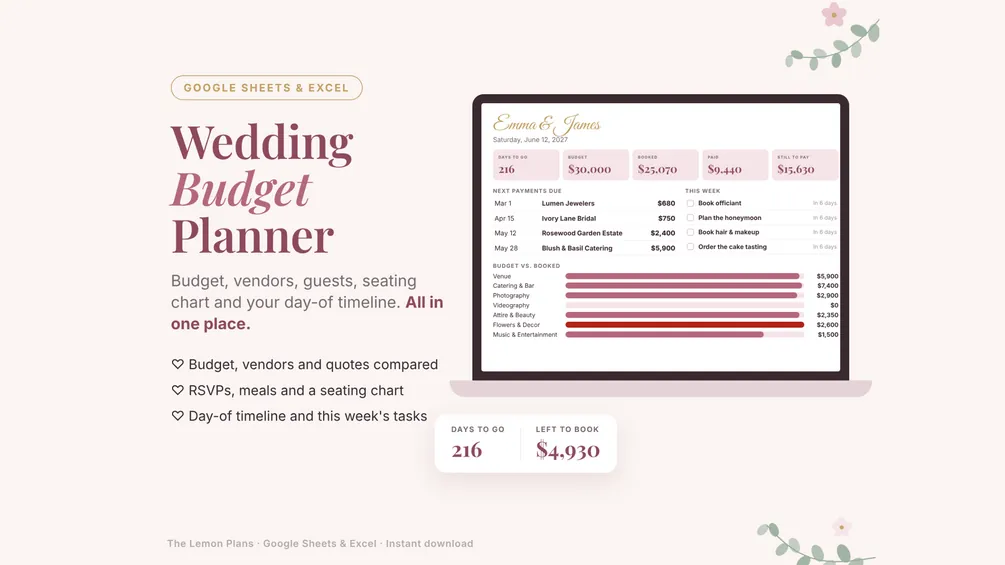
You can do all of this in a notebook, but a spreadsheet does the math for you. Our Wedding Budget Planner works in Google Sheets and Excel, with a budget by category, vendor quotes side by side and a payment tracker for deposits and due dates.
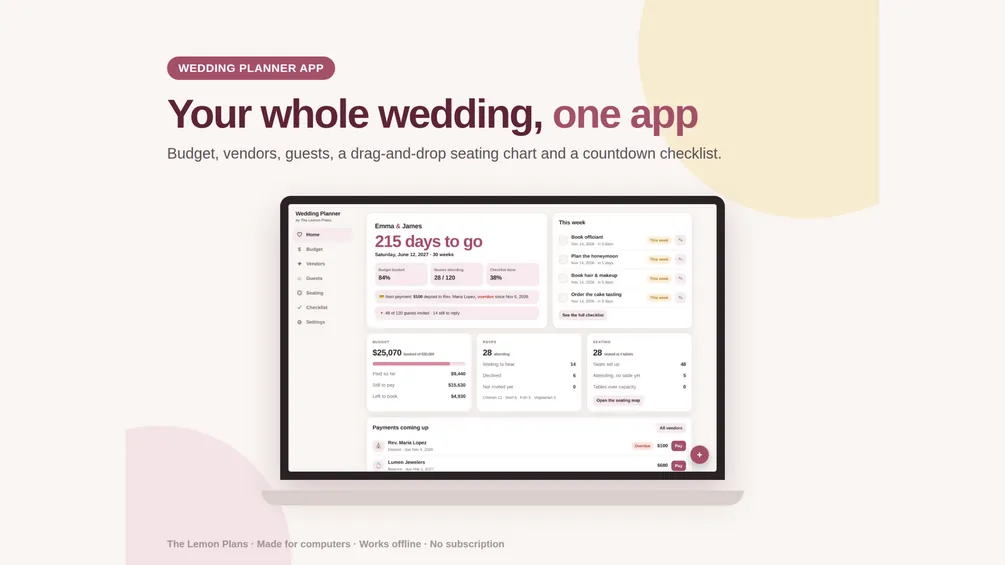
If you'd rather not use a spreadsheet, the Wedding Planner App is a simple offline app that starts with the split above, tracks vendor deposits and due dates, and keeps your data on your device. You can try the demo before buying. Both are a one-time purchase.
Once your guest list settles, the next big task is seating. Our guide on how to make a wedding seating chart walks through it step by step, and you can find more wedding tools on the wedding planning page.
The short version
Start with the percentages above, turn them into dollar limits, and then move money toward what you care about most. Keep a buffer, plan for deposit and balance dates, and look at the guest list first when you need to save. Track planned, booked and paid for every category, and your budget will tell you where you stand at any point.
This guide is general information, not financial advice. Check the numbers for your own situation.