Rental property expenses you can track for Schedule E
If you rent out a house, an apartment or a room, you normally report the rent and the costs on Schedule E (Form 1040), Part I. The form has a fixed list of expense lines. If you sort your costs into those same lines all year, tax time becomes copying totals instead of digging through receipts.
This guide walks through the Schedule E expenses list as it appears on the 2025 form, based on the IRS form, its instructions and Publication 527. It is not tax advice. Rules change and details matter, so check the current instructions or ask a tax professional before you file.
The basics before the list
- One column per property. Part I has columns A, B and C. If you own part of a property, report only your share.
- Ordinary and necessary costs. These include taxes, interest, repairs, insurance, management fees, agents' commissions and depreciation.
- Not deductible: the value of your own labor, and amounts paid for capital improvements. Improvements are recovered through depreciation.
- Timing. Most individuals use the cash method, which generally means you deduct an expense in the year you pay it.
- Personal use. If you or your family also use the property, you generally split costs between rental and personal use.
The Schedule E expenses list, line by line
Line 5: Advertising
Costs to find tenants, such as listing fees and signs. Keep the receipt and note which property it was for.
Line 6: Auto and travel
Driving and travel for your rental, such as collecting rent or maintaining the property. You generally choose between actual car costs and the standard mileage rate, which was 70 cents a mile for 2025. With the standard rate, parking fees and tolls also go here. Driving between your home and a rental is generally commuting, which isn't deductible, unless your home is your principal place of business. Travel away from home counts only if its main purpose is to collect rent or to manage, conserve or maintain the property, not to improve it. If you claim car expenses, you must complete Part V of Form 4562.
Records: a mileage log with date, places, miles and purpose, plus parking and toll receipts.
Line 7: Cleaning and maintenance
Routine upkeep, like cleaning between tenants or lawn care. Keep invoices and proof of payment.
Line 8: Commissions
Commissions you pay to agents for the rental. Mortgage commissions are different: Publication 527 says costs to get a mortgage, like mortgage commissions and recording fees, are added to the property's basis.
Line 9: Insurance
Premiums for policies on the rental. If you pay for more than one year in advance, you deduct only the part that applies to each year. Keep the policy and proof of payment.
Line 10: Legal and other professional fees
Fees for tax advice and tax preparation related to the rental, and other professional costs of running it. Legal fees to defend or protect title, recover property, or develop or improve it are added to the property's basis instead. Keep invoices.
Line 11: Management fees
What you pay a property manager. Their owner statements are a good record, since they list fees and any repairs they paid for you.
Line 12: Mortgage interest paid to banks, etc.
Interest paid to banks or other financial institutions on the rental's mortgage. If you paid $600 or more in 2025, the lender should send a Form 1098 by January 31, 2026. Only the interest goes here, not the principal. Prepaid interest and points have their own timing rules.
Line 13: Other interest
Mortgage interest paid to a lender that isn't a financial institution, or when you didn't get a Form 1098. Interest generally follows how the loan money was used, so keep records showing what each loan paid for. Keeping a loan's proceeds separate from other money makes that easiest.
Line 14: Repairs
Costs that keep the property in good working order. Keep the invoice, a note of what was fixed, and photos if you have them. See the next section for repairs vs. improvements.
Line 15: Supplies
Materials and supplies used for the rental, like cleaning products or light bulbs. Keep receipts and mark the property.
Line 16: Taxes
Property taxes on the rental. Keep the tax bill and proof of payment. Local assessments for things that raise the property's value, such as new sidewalks, generally aren't deductible and are added to the basis.
Line 17: Utilities
Utilities you pay for the rental, such as water or trash. Rental-related phone calls count, but not the base rate for the first phone line into your own home. If a tenant pays one of your bills and takes it off the rent, that payment is rental income, and you can deduct the expense.
Line 18: Depreciation expense or depletion
Depreciation spreads the cost of the building and of improvements over many years. Land isn't depreciable, so you split the purchase price between land and building. Publication 527 gives 27.5 years as the recovery period for residential rental property under the general system. Form 4562 is required in some cases, such as the year a property is first placed in service. Keep your closing statement and improvement receipts.
Line 19: Other (list)
Ordinary and necessary expenses that don't fit lines 5 through 18. For example, if you deduct actual car costs, car rental or lease payments go here. Give each item a short label so you can list it.
Repairs vs. improvements, in plain terms
A repair is deducted on line 14 in the year you pay it. An improvement is capitalized and depreciated over time.
- A repair keeps the property working the way it already did. The IRS examples are fixing a broken lock and painting a room.
- An improvement makes the property better, restores it, or adapts it to a new use. IRS examples include adding substantial insulation or replacing an entire HVAC system.
Publication 527's Table 1-1 lists more improvements, including a new roof, a deck, a fence, landscaping, a new water heater, kitchen modernization and wall-to-wall carpeting. IRS safe harbors, such as the de minimis and routine maintenance safe harbors, can change the answer for some costs. Those are good questions for a tax professional.
The IRS says to keep repair and improvement costs separate, with accurate records, because you'll need improvement costs when you depreciate or sell. To save ahead for big repairs, a sinking fund works well.
What records to keep, and for how long
You generally need documentary evidence, such as receipts, canceled checks or bills, to support your expenses. A simple set for each property:
- Leases, and a record of rent and deposits received
- Receipts and invoices, matched to bank or card statements
- Form 1098, insurance policies and property tax bills
- A mileage log
- Your closing statement and a list of improvements
Generally, keep records that support a return until its period of limitations runs out, often 3 years. Keep property records, like purchase and improvement costs, until the period of limitations ends for the year you sell or dispose of the property.
A simple monthly tracking routine
- Set up your sheet once. One row per transaction: date, property, payee, amount, Schedule E line and receipt note. A plain landlord spreadsheet works.
- Record rent as it arrives. Keep deposits you hold separate from rent.
- Once a month, sort every expense. Go through bank and card statements and give each rental cost a line and a property.
- File the proof. Save each receipt in a folder per property and year.
- Flag the hard ones. Mark anything that might be an improvement to ask your tax professional about.
- Total by line. At year end, add up each line per property to match the form.
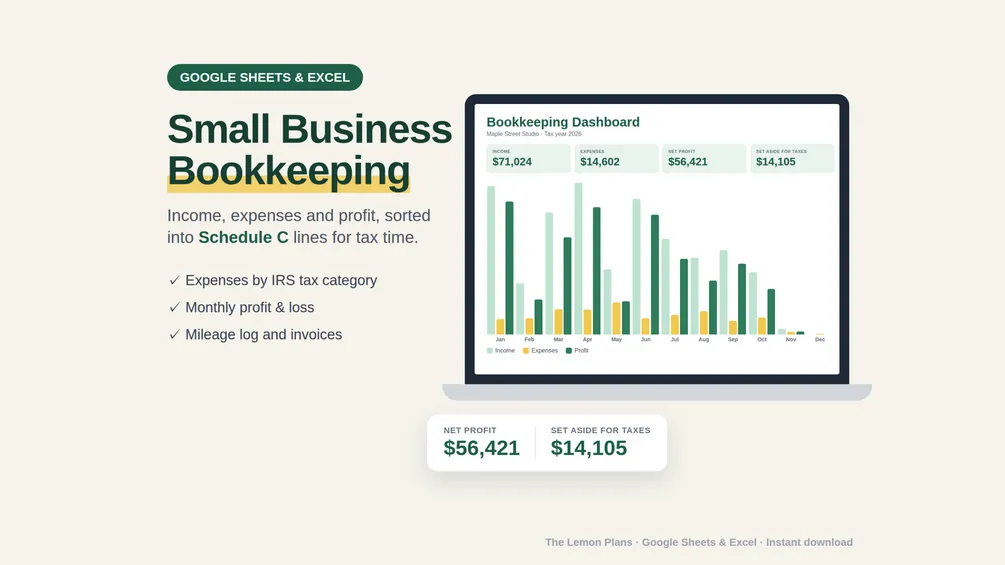
A note on our tools: we don't sell a rental property expense tracker yet. Our Small Business Bookkeeping spreadsheet is built for Schedule C, the form for a business you run as a sole proprietor, not for Schedule E. It can help if you're a landlord who also freelances or runs a side business. You can find it with our other small business planners.
This guide is general information, not tax or legal advice. Check the numbers for your own situation.