Debt snowball vs. avalanche, with a worked example
If you have more than one debt, you have to decide where each extra dollar goes. The two best-known answers are the debt snowball and the debt avalanche. Both keep every minimum paid. They only disagree on which debt gets the extra money first.
This guide explains the debt snowball vs avalanche choice in plain terms, then runs both methods on the same four debts so you can see the payoff order, the months to debt-free and the total interest side by side.
The two methods in one paragraph each
Debt snowball: list your debts from the smallest balance to the largest. Pay the minimum on everything, and put all extra money on the smallest balance. When it is gone, add its payment to the next smallest. The payment grows as it rolls down the list, like a snowball.
Debt avalanche: list your debts from the highest interest rate (APR) to the lowest. Pay the minimum on everything, and put all extra money on the highest-rate debt. When it is gone, roll its payment to the next highest rate.
The rules for both are the same in every other way:
- Your total monthly payment stays fixed. You do not lower it when a debt is paid off.
- Every debt gets at least its minimum payment every month.
- When a debt is paid off, its whole payment moves to the next debt on your list.
The example: four debts and $250 extra a month
Here is a household with four debts. The minimums add up to $615 a month, and they can add a fixed $250 on top, for a total of $865 a month toward debt.
| Debt | Balance | APR | Minimum payment |
|---|---|---|---|
| Store card | $850 | 24.99% | $30 |
| Personal loan | $4,200 | 9.9% | $135 |
| Credit card | $6,500 | 27.49% | $165 |
| Car loan | $11,300 | 7.4% | $285 |
| Total | $22,850 | – | $615 |
How the numbers were calculated: each month, interest is added at APR ÷ 12 on the current balance (rounded to the cent). Then every minimum is paid, and the rest of the $865 goes to the target debt. If a debt is paid off mid-month, the leftover money spills over to the next debt on the list that same month. We assume no new charges, no fees and no rate changes, and we treat the minimums as fixed. Real card minimums often shrink as the balance drops, so your own results will differ.
Payoff order with each method
The snowball goes by balance: store card, personal loan, credit card, car loan. The avalanche goes by APR: credit card (27.49%), store card (24.99%), personal loan (9.9%), car loan (7.4%).
| Order | Snowball: debt | Paid off in month | Avalanche: debt | Paid off in month |
|---|---|---|---|---|
| 1st | Store card | 4 | Credit card | 20 |
| 2nd | Personal loan | 13 | Store card | 21 |
| 3rd | Credit card | 26 | Personal loan | 25 |
| 4th | Car loan | 32 | Car loan | 31 |
Look at the first row. The snowball clears its first debt in month 4. The avalanche does not clear anything until month 20, because its first target is the $6,500 credit card. That long wait is the main reason some people prefer the snowball.
Months to debt-free and total interest
| Result | Snowball | Avalanche |
|---|---|---|
| First debt paid off | Month 4 | Month 20 |
| Months to debt-free | 32 | 31 |
| Interest on store card | $37.57 | $306.90 |
| Interest on personal loan | $281.27 | $577.84 |
| Interest on credit card | $2,909.98 | $1,643.97 |
| Interest on car loan | $1,463.38 | $1,434.39 |
| Total interest | $4,692.20 | $3,963.10 |
| Total paid (balances + interest) | $27,542.20 | $26,813.10 |
In this example the avalanche costs $729.10 less in interest and finishes one month sooner. The snowball pays less interest on the small debts, but much more on the 27.49% credit card, because that card waits in line longer while its balance keeps growing.
What the example shows
- The avalanche usually costs the least interest. Sending extra money to the highest rate first attacks the most expensive balance, so it is normally the cheapest order.
- The gap depends on your rates. Here the biggest rate sat on a mid-sized balance, so the gap was about $700. If your highest rate is also your smallest balance, both methods pick the same order and the result is identical.
- The snowball buys early wins. Two debts were gone by month 13 with the snowball. With the avalanche, the first one took 20 months.
- The fixed total payment matters more than the order. Both plans finish in under three years because the household keeps paying $865 every month, even after debts disappear.
Debt snowball or avalanche: which fits you?
There is no single right answer. The cheaper plan only helps if you keep following it. A few questions can help you decide:
- Are your interest rates far apart? If one debt is at 27% and another at 7%, the avalanche usually saves more. If all your rates are close, the difference may be small.
- Have you started and stopped before? If you lost steam last time, the quick wins of the snowball may be worth the extra interest.
- Is your highest-rate debt very large? Some people use a hybrid: clear one or two tiny balances first for a quick win, then switch to avalanche order.
- Does a debt have a promo rate ending soon? A 0% card that jumps to a high rate in a few months may need to move up your list, whichever method you use.
Whichever you pick, the plan only works if the money is really there each month. A written budget helps with that. Our guide on how to make a zero-based budget shows how to find a fixed extra amount and give it a line of its own.
How to run your own numbers
- Pull your latest statements. Write down each balance, APR and minimum payment.
- Decide on a total monthly amount you can keep paying, including the extra.
- Sort the list two ways: smallest balance first, then highest APR first.
- Run both orders month by month, with interest at APR ÷ 12, and roll each payment forward when a debt is paid.
- Compare the month of your first payoff, your debt-free month and total interest.
You can do this with a pencil, but it gets slow past two or three debts. A debt snowball spreadsheet in Google Sheets or Excel, or a debt avalanche calculator, does the month-by-month math for you. If you are not sure where to start at all, the free Debt Payoff Starter Checklist walks through the first ten steps on one printable page.
Tools from The Lemon Plans
If you would rather not build the sheet yourself, we make two tools that run both methods on your own debts. You pay once, with no subscription, and your numbers stay on your device.
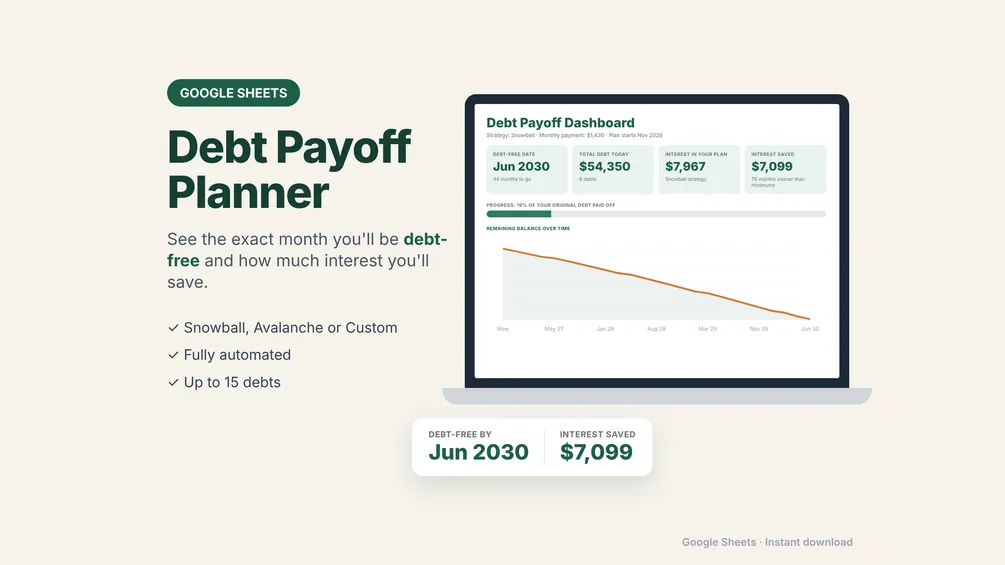
- The Debt Payoff Planner for Google Sheets and Excel shows your debt-free date and the interest you save, with snowball, avalanche or your own order, month by month, for up to 15 debts.
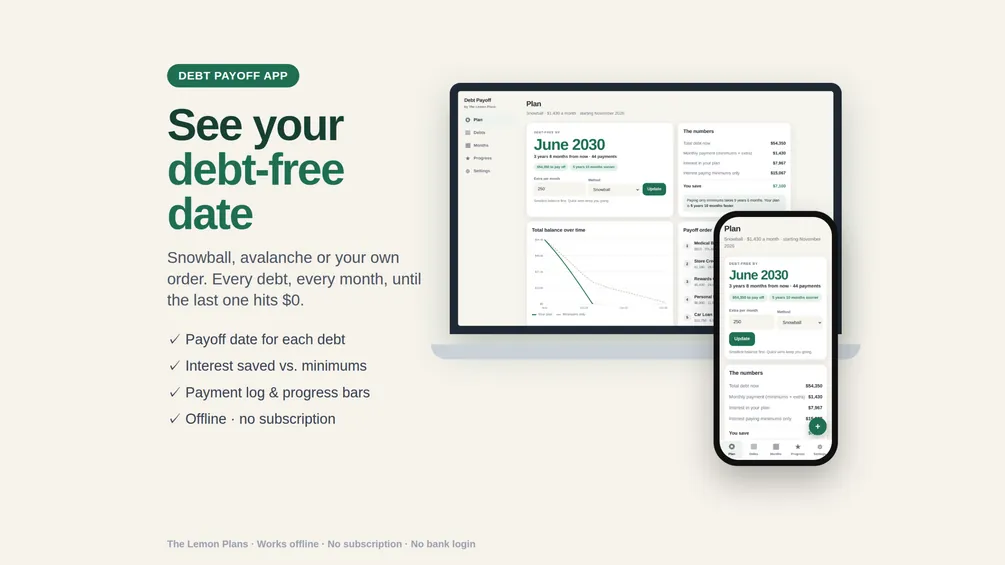
- The Debt Payoff App is a simple offline browser app with the payoff date of every debt, a payment log and a balance chart. You can try the demo before you buy.
You can see everything for paying down debt on the debt payoff page.
This guide is general information, not financial advice. Check the numbers for your own situation.