Sinking funds: what they are and how to start
A sinking fund is money you set aside, a little at a time, for a cost you already know is coming. Car insurance renews every six months. The holidays arrive every December. Your car will need tires at some point. None of these are surprises, but they often feel like one because the whole bill lands in a single month.
Sinking funds fix that. You take the full cost, divide it by the months you have left, and save that amount each month. When the bill arrives, the money is already there. This guide shows you how to choose your funds, do the math for monthly or biweekly pay, and keep the money somewhere sensible.
Sinking funds vs. an emergency fund
Both are savings, but they do different jobs.
- An emergency fund is for things you can't plan: a job loss, a medical bill, a sudden trip home. You don't know when you'll need it or how much.
- A sinking fund is for things you can plan: you know roughly what it will cost and roughly when. Each fund has a name, a target and a date.
Keeping them apart matters. If you pay for holiday gifts out of your emergency fund, the emergency fund is smaller when a real emergency shows up. Sinking funds protect your emergency fund by covering the predictable costs first.
How to pick your sinking funds
Start with last year. Go through 12 months of bank and card statements and write down every cost that didn't happen every month. Most people find the same kinds of items:
- Insurance paid every 6 or 12 months (car, renters, home, life)
- Car costs: registration, tires, oil changes, repairs
- Holidays, birthdays and other gifts
- Travel and vacations
- Annual memberships, subscriptions and software renewals
- Back-to-school clothes and supplies
- Home repairs and replacing appliances
- Medical costs you expect, like dental work or new glasses
- Pet care, such as yearly vet visits
You don't need all of them. Pick the three to six that hurt the most when they come due, and start there. A short sinking funds list you actually fund beats a long one you ignore. You can add more once the first few feel routine.
For each fund, write down three things: the target amount, the date you need it, and how much you already have saved for it. If you don't know the exact cost, use last year's amount and round up.
How to calculate sinking funds
The basic formula is short:
Monthly amount = (target − already saved) ÷ months left
If your car insurance costs $720 every six months and you have nothing saved yet, you need $720 ÷ 6 = $120 a month.
If you're paid by paycheck instead of by month, convert the monthly amount to a per-paycheck amount:
- Biweekly pay (26 paychecks a year): monthly × 12 ÷ 26
- Weekly pay (52 paychecks a year): monthly × 12 ÷ 52
- Twice a month (24 paychecks a year): monthly ÷ 2
Why not just divide the monthly amount by two for biweekly pay? Because biweekly pay gives you 26 paychecks, not 24. Twice a year you get a third paycheck in one month. Using × 12 ÷ 26 spreads the yearly total evenly across all 26 checks, so you don't over-save in some months and fall behind in others.
If you start late or skip a month, don't try to catch up all at once. Run the formula again with the new amount saved and the new months left. The monthly number goes up a bit, and you're back on track.
An example with six funds
Here is a sample plan for one household. The monthly column is the target divided by the months left. The biweekly column is the monthly amount × 12 ÷ 26, rounded to the cent.
| Fund | Target | Months left | Per month | Per biweekly paycheck |
|---|---|---|---|---|
| Car insurance (6-month premium) | $720 | 6 | $120.00 | $55.38 |
| Holiday gifts | $600 | 12 | $50.00 | $23.08 |
| Car repairs and tires | $900 | 12 | $75.00 | $34.62 |
| Annual memberships and renewals | $180 | 12 | $15.00 | $6.92 |
| Summer vacation | $1,500 | 10 | $150.00 | $69.23 |
| Back-to-school | $300 | 10 | $30.00 | $13.85 |
| Total | $4,200 | $440.00 | $203.08 |
Two things stand out. First, $440 a month is a real number, so it has to fit in your budget like any other bill. If it doesn't fit, push a date out, lower a target, or drop a fund for now. Second, the car insurance fund refills: once you pay the premium, the next six-month cycle starts and the $120 a month keeps going.
If you use a zero-based budget, each sinking fund gets its own line, just like rent or groceries. That way every dollar has a job, and the yearly bills have one too.
Where to keep sinking fund money
The main rule is simple: keep it out of your everyday checking balance, where it's easy to spend by accident. Common options:
- A separate savings account. Many people use one high-yield or regular savings account for all their funds and track each fund's share on paper or in a spreadsheet.
- Several labeled savings accounts. Some banks and credit unions let you open more than one savings account or create named sub-accounts. This shows each fund's balance at a glance.
- Cash envelopes. This works for small, short-term funds like gifts. It's harder for big amounts and earns no interest.
Since this money has a near-term job, most people keep it somewhere easy to reach and stable in value, not in investments that can drop right before the bill is due. Check fees, minimum balances and transfer limits before you choose an account.
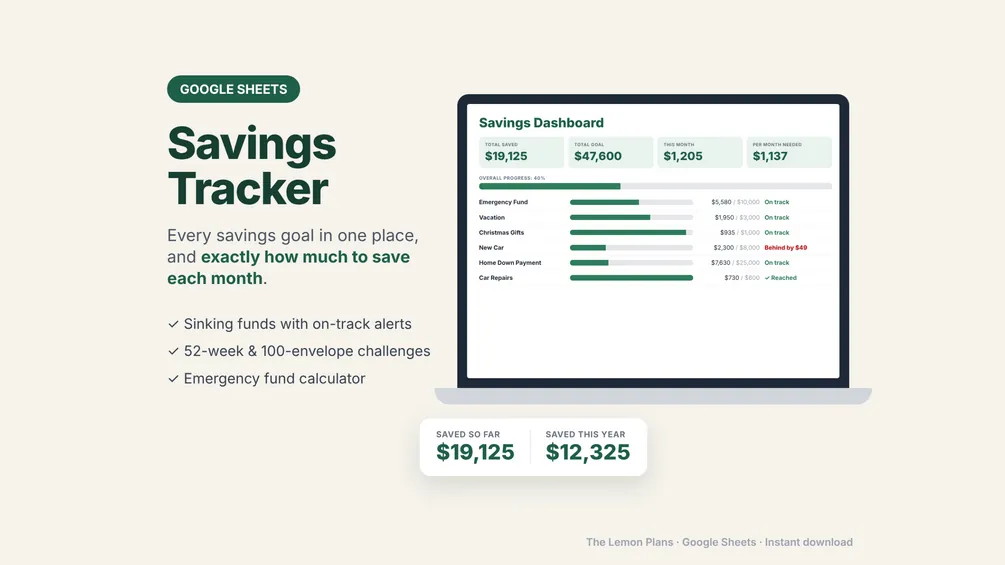
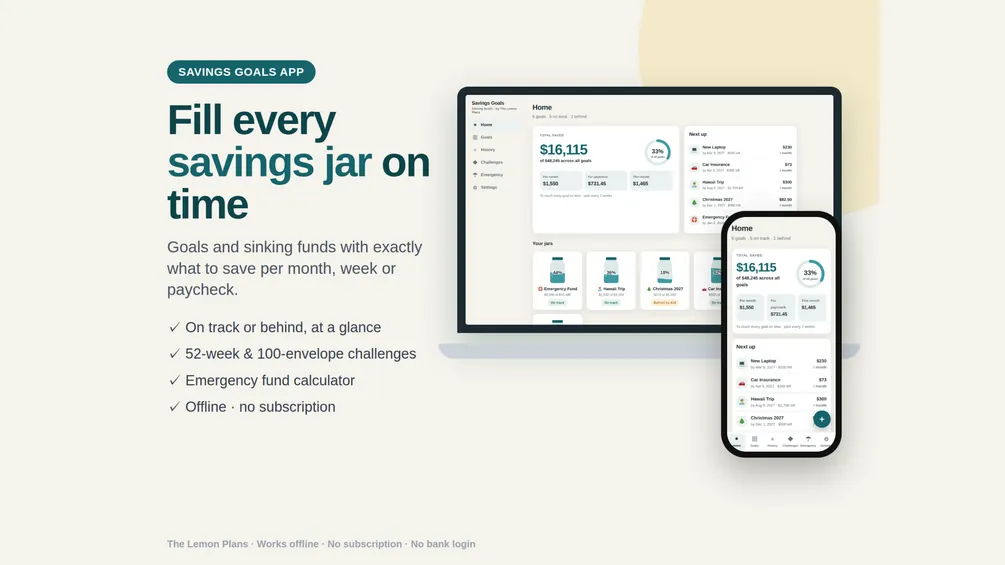
If all your funds share one account, you need a sinking funds tracker so you know how much of the balance belongs to each fund. That can be a notebook, a spreadsheet like the Savings Tracker for Google Sheets and Excel, or the Savings Goals & Sinking Funds App, which runs offline in your browser. You can try the app demo before you buy. Whatever you use, record each deposit and each withdrawal, and check that the fund totals add up to the account balance once a month.
Two savings challenges, in brief
Savings challenges are not sinking funds, but they can kick-start one. Both have fixed totals you can check yourself.
52-week savings challenge
You save $1 in week 1, $2 in week 2, and so on, up to $52 in week 52. The total is $1 + $2 + … + $52 = $1,378. Some people do it in reverse, starting at $52, so the larger amounts come early. The average is $26.50 a week.
100-envelope challenge
You number 100 envelopes from $1 to $100, pick one at random, and put that amount in it. When all 100 are full, you have $1 + $2 + … + $100 = $5,050. The average envelope is $50.50, so the pace you choose matters. One envelope a day takes about 14 weeks and needs about $50 a day on average. Two envelopes a week takes about a year.
Either challenge can fill a single large fund, like a vacation or a car repair cushion. Just decide up front which fund the money is for.
How to start this week
- List the non-monthly costs from your last 12 months.
- Pick three to six funds and write a target and a due date for each.
- Work out the monthly amount: (target − saved) ÷ months left. Convert it to per paycheck if that's how you're paid.
- Add the total to your budget as one or more bills.
- Choose where the money lives and set up an automatic transfer for payday.
- Once a month, update each fund's balance and recalculate if a date or cost changed.
Start small if you need to. Even one fund for your next big bill changes how that month feels. For more ways to plan and track savings goals, browse our savings planners.
This guide is general information, not financial advice. Check the numbers for your own situation.